What Is the Jarrah Tree & Why Is Its Honey So Rare & Prized Worldwide?


One of the common questions I get asked often is what is Jarrah Honey and where does it come from? The Jarrah tree (Eucalyptus marginata) grows naturally in the ancient forests of Southwest Western Australia—nowhere else on Earth—producing a nectar that bees turn into one of the world’s most coveted honeys. Bloom is sporadic, supply is tiny, and authentic jars sell out fast. At Bee Bee Natural, we harvest ethically, put bees first, and lab-test every small batch. That’s how our Jarrah TA 63—among the highest activity ratings you’ll see—earns its reputation for exceptional quality.

The Jarrah Tree: A Wild WA Original
Jarrah is endemic to Western Australia’s southwest. It thrives in vast, low-impact forests far from intensive agriculture—one reason genuine Jarrah honey is prized for cleanliness and provenance. Western Australia has maintained particularly strong biosecurity and surveillance to protect its bee industry and forest honey reputation.
Why Jarrah Honey Is Genuinely Rare
-
Limited range: Jarrah grows only in WA’s southwest.
-
Infrequent flowering: Trees can flower on a biennial (or irregular) cycle and for a short window, so production opportunities are scarce.
-
Weather-dependent: Rainfall and warmth determine bloom quality and timing; some years yield little to no Jarrah honey.
-
Global demand: Awareness of Jarrah’s unique profile has grown faster than supply.
In short: small geographic range + irregular bloom + high demand = naturally limited volumes. That scarcity is built into the forest—not a marketing trick.
Ethical Beekeeping, Bees-First: How We Do It
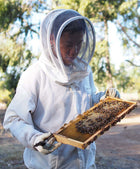
Our ethic is simple: bees eat first; we only harvest true surplus. We run small batches, have zero chemical use on our hives, and cold-extract to preserve natural enzymes and aromatics. We keep our bees deep in natural forage, away from urban contaminants, and move with the seasons—not against them. Western Australian honey research bodies have long highlighted the premium nature of monofloral WA honeys (like Jarrah and Marri) when produced carefully and kept raw.
-
No shortcuts: No blending with cheaper syrups, no heat-pasteurising to “polish” appearance, no gimmicks.
-
Traceable: Direct from a Singaporean beekeeper in WA to you—so you know exactly who looked after the bees producing your jar.
-
Tested, not guessed: Each batch is lab-tested for Total Activity (TA) so you can see the real antibacterial strength.

TA 63: What That Means—and Why It Matters
“Total Activity” (TA) measures honey’s broad-spectrum antimicrobial power (largely peroxide-based in Jarrah). WA research has repeatedly shown Jarrah to be among Australia’s strongest honeys by antimicrobial activity. TA 63 is an exceptionally high result that signals outstanding potency for a food honey. Contemporary lab and academic work on WA honeys continues to demonstrate robust antibacterial effects in vitro.
(Note: TA is different from Manuka’s UMF/MGO system—but both aim to quantify activity. For a plain-English comparison, see our explainer below.)
Why Many Singaporeans Choose Jarrah Daily
-
Naturally powerful: Independent research on WA honeys reports strong antibacterial effects (including against challenging bacteria in lab settings).
-
Low-GI sweetness: Studies on Jarrah have measured low glycaemic index profiles compared with conventional sugars—great when you’re moderating sugar without giving up flavour.
-
Antioxidant-rich: Current research continues to map the phenolics behind Jarrah’s antioxidant capacity—another reason discerning buyers seek single-origin WA honey.

How to find the Real Thing
-
Expect raw, unblended, unpasteurised.
-
Seek independent lab results (TA value for Jarrah).
-
Buy from sources that explain ethics and seasonality, not just price.
- Look for origin clarity: Western Australia, single-origin Jarrah.
FAQs
Is Jarrah honey really from just one place?
Yes—Jarrah (Eucalyptus marginata) is native to Southwest Western Australia; that’s why supply is naturally limited and highly seasonal.
Why does Jarrah honey cost more?
Limited range, infrequent flowering, and strong global demand. Add ethical small-batch harvesting and lab testing, and you have a premium product by definition.
What does TA 63 tell me?
It’s an exceptionally high Total Activity level—an indicator of powerful, broad-spectrum antibacterial strength in lab assays. WA research shows Jarrah is among Australia’s strongest honeys by activity.
Is Jarrah honey low-GI?
Studies have measured Jarrah honey with low glycaemic index values compared with regular sugars. As with any honey, enjoy in moderation.